

December 15, 2025
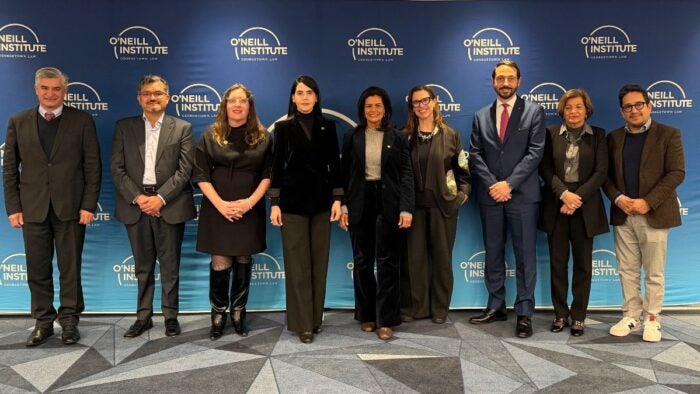
Washington, D.C. — Last week, the O’Neill Institute’s Center for Health and Human Rights at Georgetown Law and Ríos Strategic Lawyering for Social Justice held the second annual “Judicial Dialogues on Health and the Law in Latin America and the Caribbean” event, bringing together high court justices from across the region to promote meaningful dialogue between judges, academics, and experts and reflect on shared challenges and opportunities.
The event featured Justice Natalia Ángel Cabo of the Constitutional Court of Colombia, Justices Army Ferreira Reyes and María del Carmen Santana de Cabrera of the Constitutional Tribunal of the Dominican Republic, Chief Justice Daniela Marzi Muñoz of the Constitutional Tribunal of Chile, Justice Rubenia Galeano Barralga of the Supreme Court of Justice of Honduras, and Justice Alí Lozada of the Constitutional Court of Ecuador. It also included contributions from Christian Courtis of the UN Office for the High Commissioner of Human Rights and Professor Gonzalo García Pino, former Justice of the Constitutional Tribunal of Chile, whose perspectives enriched the event’s comparative and interdisciplinary discussions.
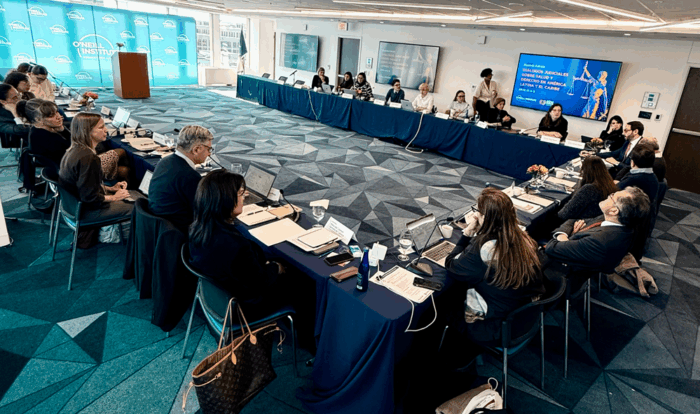
The “Judicial Dialogues” provided a space for judges and experts to examine the evolving challenges of protecting health through rights-based approaches in Latin America and the Caribbean, including non-retrogression and the protection of health and related rights, the regulation of private actors in healthcare, and sexual and reproductive health. Over two days, participants explored ways to address the complexities of health litigation and strengthen access to justice, underscoring how transnational learning and peer exchange are essential to advancing these goals.
In a session on non-retrogression and the protection of the right to health and related rights, Justices and experts examined the principle of non-retrogression as a central safeguard in States’ obligations to advance the effective enjoyment of social rights. Courtis explained that, under international and constitutional doctrine, States may not adopt measures that unjustifiably reduce existing levels of protection, a rule that triggers a high standard of justification requiring legitimate aims, necessity, and preservation of minimum essential levels. Justices discussed how their courts apply this principle in practice.
Justices and experts also participated in a session on the regulation of private actors and judicial avenues for the protection of health. In this session, Justices examined the influence of private actors in shaping health outcomes and the constitutional duty of States and courts to regulate their activity. Using examples ranging from the marketing of harmful products like tobacco and ultraprocessed foods, participants discussed how constitutional and international human rights frameworks provide tools to protect the right to health and related rights. The dialogue highlighted common challenges across the region, including corporate interference, regulatory gaps, and strategic litigation from industries seeking to avoid oversight.
In a session on the judicial protection of reproductive health, Justices discussed how, over the past decade, Latin America has seen significant developments in this field, with key judicial decisions advancing the decriminalization of abortion and supporting legislative reforms. Despite this progress, major challenges persist, including the total prohibition of abortion in some countries and the need to ensure equitable access to quality services where abortion is legal. The session explored how high courts confront the tensions involved in balancing constitutionally protected rights, implement reproductive rights in practice, and identify lessons and strategies to strengthen access to reproductive health services.
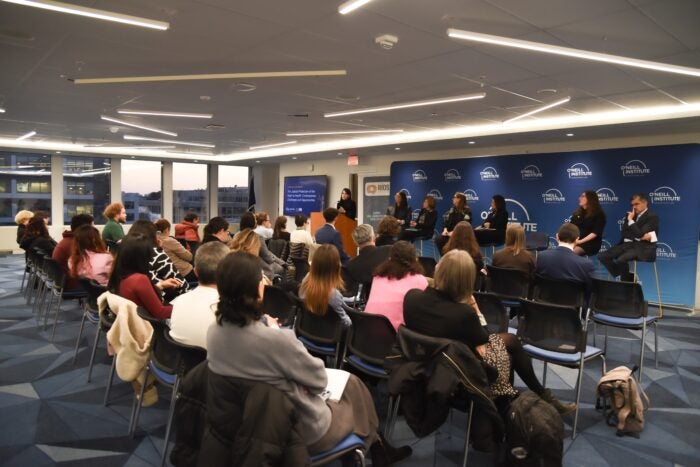
The event culminated in a public conference that provided a space for Justices to discuss and reflect on the challenges and tensions that arise in the judicial enforcement of the right to health and related rights, and reflected on a range of issues that often emerge in their work and how these are addressed in their respective countries.
The Center for Health and Human Rights and Ríos Strategic Lawyering for Social Justice hope to continue providing a platform for Justices and legal experts to exchange ideas and strengthen the role of the judiciary in advancing health and human rights through future “Judicial Dialogues.” The success of the past two editions underscores the need for spaces that foster deeper collaboration among courts and academics across Latin America and the Caribbean.