

May 22, 2026
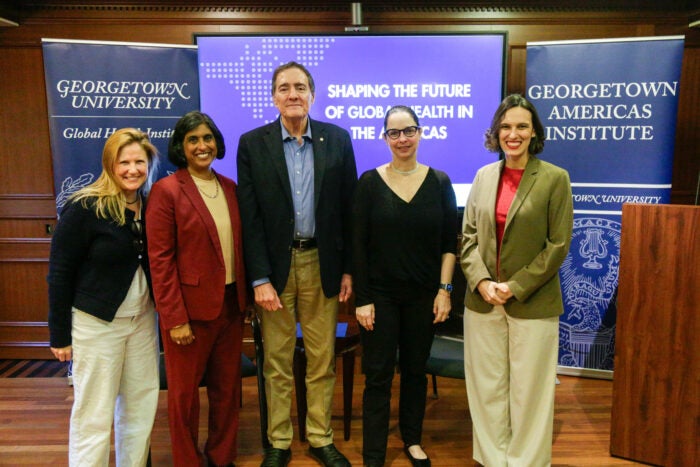
On April 30, 2026, the Center for Health and Human Rights, the Georgetown University Global Health Institute, the Georgetown University Americas Institute, and the Georgetown University Science, Technology, and International Affairs program hosted a conversation with Dr. Jarbas Barbosa, Director of the Pan American Health Organization (PAHO), on the evolving health landscape in the Americas.
The discussion, moderated by Denisse Yanovich, managing director of the Georgetown University Americas Institute, explored key regional health challenges, including misinformation, barriers to vaccination, health system inequities, and the future of global health leadership.
Founded in 1902, PAHO is the world’s oldest international health organization, working across 51 countries and territories throughout the Americas. During the conversation, Dr. Barbosa reflected on the region’s rapid demographic transition, the persistent inequities affecting Indigenous and Afro-descendant communities and those living in rural areas, as well as the structural barriers that continue to shape access to healthcare.
Discussing misinformation and declining trust in science following the COVID-19 pandemic, Dr. Barbosa highlighted the growing volume of unverified health claims on social media competing with evidence-based guidance and emphasized the importance of adapting public health communication strategies to better reach communities.
The conversation also addressed the broader social and economic barriers that contribute to under-vaccination across Latin America. Dr. Barbosa noted that, even when vaccines are available at no cost, factors such as transportation, clinic accessibility, and lost wages can prevent families from accessing care. He emphasized the need for governments and health systems to use data more effectively to identify underserved populations and develop strategies tailored to their needs.
Additionally, Dr. Barbosa discussed PAHO’s efforts to support innovative, cross-sector approaches to healthcare delivery in hard-to-reach settings. He cited the organization’s work in Paraguay as an example of this approach, where mobile X-ray units and artificial intelligence technologies have been used to improve tuberculosis screening in prisons while reducing logistical burdens on health systems.
The event concluded with reflections on the future of global health and advice for emerging professionals in the field. Dr. Barbosa encouraged students and young practitioners to remain adaptable, question long-standing assumptions, and cultivate interdisciplinary perspectives to more effectively translate policy into practice.
“The most important thing,” Dr. Barbosa said, “is to keep your mind open and always ask: how can I do better?”
Isabel Barbosa from the Center for Health and Human Rights offered closing remarks.
A full recording of the event is available here: https://www.youtube.com/watch?v=asltElNRs60